It was 4:07 a.m., Sunday when the mystical dragon responded from Incheon.
Which is to say that was the time on this side of the ocean the first baseman of the SK Wyverns connected from South Korea. SK is the conglomerate that sponsors the team. Wyverns translates to mystical dragons.
Jamie Romak is the only Canadian baseball player currently playing in the just-underway Korean pro league. He holds the Canadian record for foreign league home run in a single season with 45 from 2018 set with his current club.
The London, Ont. native who made it to the majors with the Dodgers and Diamondbacks, ought to sign on as a consultant with the Toronto Blue Jays when it comes to the MLB plans of returning to action in empty stadiums.
If there has been a nation that has provided an example of how to manage the COVID-19 pandemic, it’s been Korea. And the eyes of every major professional sports league in the world ought to be on the Korean league.
SEOUL, April 7 (Yonhap) — With each passing day, the South Korean baseball league is growing hopeful that it can still play a full, 144-game season, despite the wrench thrown by the coronavirus outbreak earlier in the year.
The 2020 regular season for the Korea Baseball Organization (KBO) would have begun on March 28 under normal circumstances. But the COVID-19 pandemic forced the KBO, much as all other South Korean sports organizations, to put its season on hold.
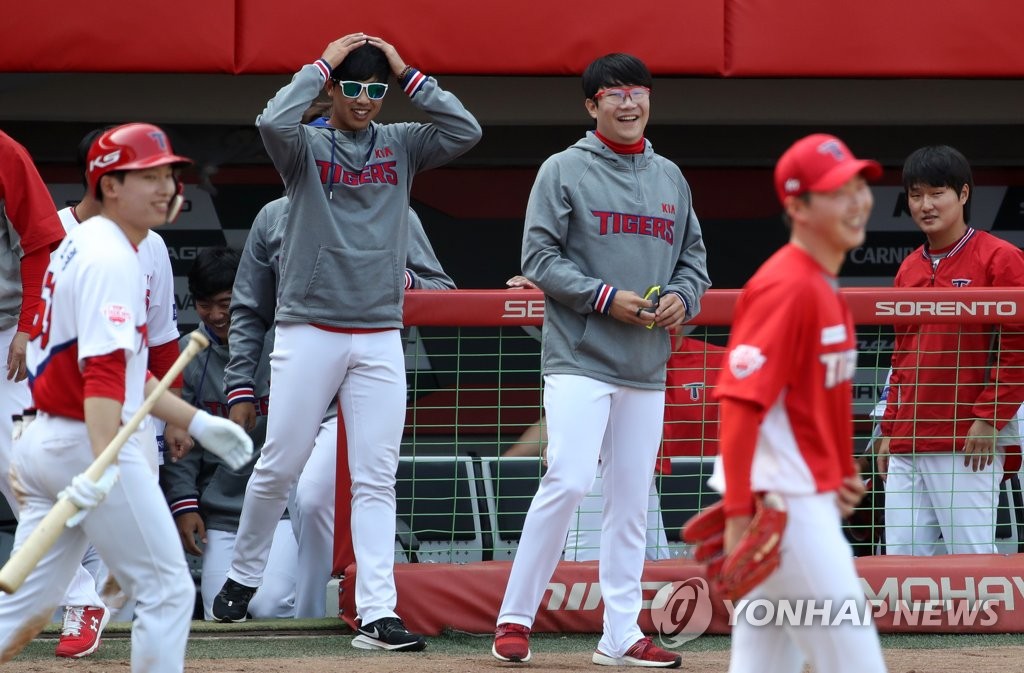
The Kia Tigers play their intrasquad game at Gwangju-Kia Champions Field in Gwangju, 330 kilometers south of Seoul, on April 7, 2020. (Yonhap)
Even as volleyball and basketball seasons were being canceled, and the football league wasn’t even discussing a new kickoff date, the KBO, almost defiantly, kept its sights set on a late April or an early May start. As long as the season begins in the first week of May, league officials said, there will be enough of a window to salvage a 144-game season.
What once seemed like a highly unlikely scenario has become an almost feasible proposition this week, as the number of new virus cases stayed below 50 for two consecutive days.
That has fed optimism around the league.
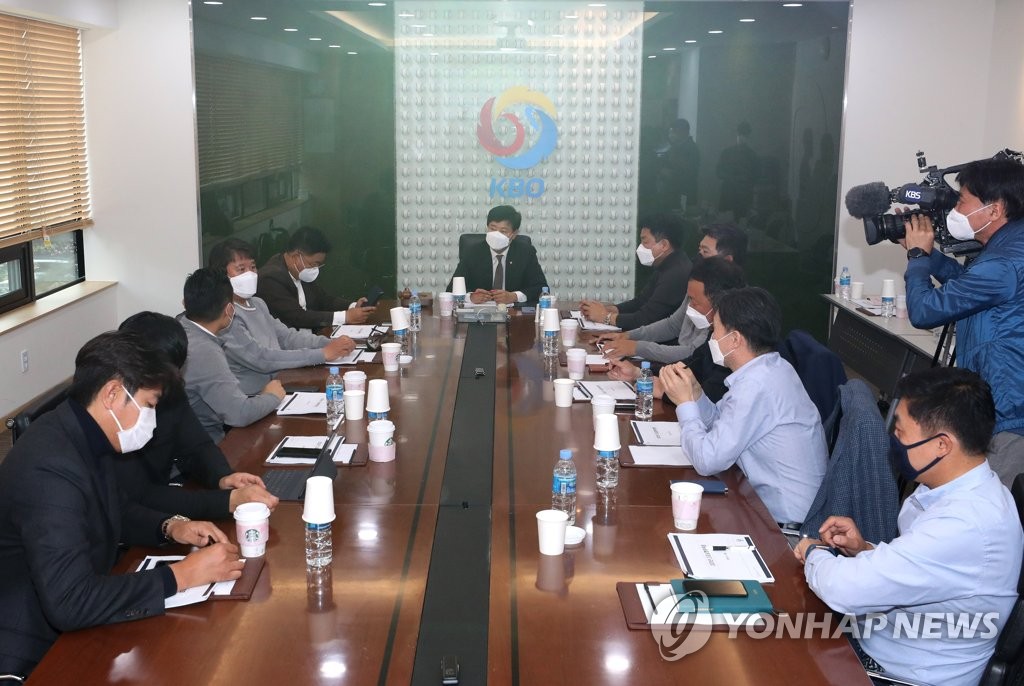
“The recent downward trend has obviously impacted our discussions,” said KBO’s secretary general Ryu Dae-hwan, following an executive committee meeting with club general managers. “As long as we can start the season in early May, we’ll be able to finish everything by the end of November.”
The latest conclusion to a KBO season came in 2018, when the SK Wyverns knocked off the Doosan Bears in Game 6 of the best-of-seven Korean Series on Nov. 12. That season included an 18-day, midseason break to accommodate the Asian Games in Indonesia, with the national team being represented by KBO stars.
This year’s original schedule also included an 18-day layoff for the Tokyo Olympics from July to August. But the Olympic Games have since been postponed to next year, giving the KBO some leeway. The KBO has already canceled All-Star festivities, and Ryu reiterated on Tuesday that an early May start will necessitate double headers and games on Mondays, normally a designated off day in the KBO.
The recent drop in COVID-19 cases also keeps the KBO on course to begin the preseason on April 21. To prevent the spread of the virus, teams are only allowed to play intrasquad games at their own stadiums, with no traveling allowed. But if the preseason begins on time, the league’s 10 clubs will be able to play one another, albeit with limited traveling. The league will schedule games so that only teams that are close to each other will be playing and visiting teams will be able to return to their home cities the same day.
Trying not to sound too giddy in this public health crisis, Ryu said the KBO’s plan will only hinge upon how well the virus is contained in the coming days.
“We’re seeing fewer than 50 cases, but we feel that the number will have to be far lower than that,” Ryu said. “There are a lot of factors we have to consider. Government guidelines are important, too.”
Even if the KBO gets its wishes and begins the regular season in early May, at least some of the early contests will be played behind closed doors, Ryu said.
One possibility is for the teams to start playing without fans and then to gradually increase the number of spectators. For instance, a team whose home stadium sits 20,000 could first sell only 10 percent of the seats and make sure those 2,000 fans are spread apart across the ballpark. And then the team could increase that number to 20 or 30 percent of the seats, depending on how well the virus is contained by then.
And to ensure the safety of players and others involved in crowdless games, the KBO came up with its own set of guidelines.
Players and coaches will be “strongly recommended” to wear masks in all areas of the stadium, except for the dugouts and the field. Umpires and official scorers will be required to wear masks at all times during games, and their travel from one stadium to another will be kept to a minimum.
The first confirmed case of COVID-19 in the United States and the first confirmed case of COVID-19 in South Korea occurred on the same day. In the two months since then the course of each country’s outbreak has been radically different.
As of a week ago, the United States was reporting around 15 times more confirmed COVID-19 cases and deaths than South Korea despite having only about six times the population. South Korea has likewise reduced its rate of new daily cases to one-tenth of its peak while the United States likely won’t see its peak for some time.
The biggest factor in that disparity is that South Korea began ramping up testing more quickly and implementing preventive measures, such as school closures and stay-at-home orders earlier and in uniform, as opposed to piecemeal fashion as we have done in the U.S. South Korea is not out of the woods yet — they are currently bracing for a second wave of COVID-19 — but they flattened the curve more effectively and are thus ahead of us on the timeline.
It’s an interesting read, but my biggest takeaway from it is not necessarily about what we should have done vs. what Korea has done or anything like that. I mean, there are countless ways the United States has completely screwed up its COVID-19 response via incompetence and worse, but this ESPN article does not get into that in a super effective way, nor does it take into account various differences between the U.S. and South Korea, separate and apart from the competence of its leaders, which would likely have led to at least some level of disparate results regardless. That’a a topic best left to a more in-depth article.
No, my biggest takeaway is how precarious and uncertain the return of baseball is even in South Korea, where things have gone better than in most places. As the article notes, one sick player, one sick trainer, and the timeline will be pushed back farther. And even if that doesn’t happen, the normal acts of ballplayers — getting a new ball from the ballboy to the ump to the catcher to the pitcher — are all coming under new scrutiny and are cloaked in uncertainty and unease.
It’s the sort of thing that makes me seriously question whether professional sports can come back on anything approaching the timeline those in power are currently envisioning. And whether they should be coming back this year at all.



 The view from left field