An enigma to the end, Byfuglien will always be loved in Winnipeg — Winnipeg Sun

The rhythm was often off-beat. Read More

An enigma to the end, Byfuglien will always be loved in Winnipeg — Winnipeg Sun

The rhythm was often off-beat.

The marching was far from an organized stride.

Dustin Byfuglien did his own thing.

Always.

It was his beat. His march. It only needed to make sense to him.

And just as his career began in an eccentric way — getting a phone call about rookie camp in Chicago and then going AWOL until someone from the Blackhawks organization tracked him down to get him there — it ended on a similar note.

You’d be hard-pressed to find someone willing to walk away from $14 million. Even professional athletes, who’ve amassed vast amounts of wealth over their respective careers, often want to maximize those earnings before their body won’t allow them to any longer.

But one of hockey’s most entertaining and enigmatic figures seemingly didn’t care about all of that in the end.

Money, reputation, legacy — these things simply failed to compute in a logical way for a player shrouded in as much curiosity as Byfuglien is (or was, at this point).

Byfuglien did Byfuglien. 24/7. 365 days a year, and he didn’t let his guard down on a leap year, either.

That mystique is a big reason fans embraced him so dearly, and why we media types were always searching for more.

Surely, he knew that.

Fans learned much about the man in the way he carried himself on the ice. That’s how he communicated with them. He was merciless to his opponents — just ask Mark Stone or Roberto Luongo — and fiercely competitive.

But he was also a consummate teammate — just ask anyone not named Evander Kane. And it’s not just his most recent teammates that speak his praises, but also his former colleagues in Chicago.

The story about Byfuglien’s first rookie camp came from long-time Blackhawks defenceman Duncan Keith a few months ago. Keith’s memories of Byfuglien as a teammate were glowing.

On the homefront, he took Josh Morrissey under his wing.

Byfuglien was the family protector, a job he did admirably, and a job his teammates admired.

Jets general manager Kevin Cheveldayoff spoke Friday of an emotional ending that began back in early September on the eve of training camp. The months-long saga came to an end 219 days later as the NHL, the NHLPA and the Jets announced the termination of Byfuglien’s contract.

That Byfuglien was emotional back then is certainly believable, and one wonders if the finality of today wouldn’t have elicited similar sentiments.

While there are parts of the game — the media, particularly — that Byfuglien never seemed to enjoy, he most certainly relished playing the game, playing in big games, and being a part of the team. And those around him enjoyed it, too. He had that infectious trait about him.

That seeped into the fan base here in Winnipeg. Supporters would have loved for Byfuglien to play forever. That just comes with the territory when you have a player as popular, and as effective, as the 35-year-old was for the Jets.

If Byfuglien’s career is truly over, he leaves the game having hoisted the game’s holy grail. He completed the goal most prominent among every player that’s stepped onto the ice in the National Hockey League.

He also wasn’t a flash in the pan. He played nearly 900 games. He played on the biggest stages the game can offer. He thrived in those moments, too, much to the chagrin of Vancouver Canucks fans, and others throughout his career.

Perhaps most importantly, he did so in front of a legion of fans he earned through playing the game the way he wanted to play.

And if there’s a lesson to take for any player, young, old, and in between, it’s just that: you can be yourself, and true to yourself, while at the same time being good at whatever it is you do in life.

Byfuglien went out on his own terms, and not everyone gets to say that.

And judging by the reaction to the comments from Cheveldayoff on Friday, it sounds like many, if not all, fans accept Byfuglien’s terms.

We don’t have the full story. We may never hear Byfuglien’s side in this whole ordeal.

But unless Cheveldayoff was fibbing, Byfuglien remained loyal to the Jets until his final day as a member of the organization. He didn’t want to be traded, even when asked multiple times. It appeared that it was Winnipeg or bust.

In the end, Byfuglien chose both.

While pain once again ripples through the city, this is the Byfuglien the fans know and love.

And love, they always will.

Behind the Dream: Marcus Reyes is a relief pitcher from Vista, CA. He played at San Diego State University before being drafted by the Toronto Blue Jays in 2017. Last season (2019), he played for the Class-A Lansing Lugnuts. — Ballpark Vibes

Q: What’s your favorite baseball movie? I’d probably say Major League because of the camaraderie they show in the movie and it’s just a bunch of misfits. They all ball out, but they are degenerates. It’s just a fun comedy baseball movie! Q: Who was your favorite team growing up? So, I had two favorite […]

Behind the Dream: Marcus Reyes — Ballpark Vibes

Q: Who was your favorite team growing up?

So, I had two favorite teams. Obviously the San Diego Padres, just because I’ve lived in San Diego County since I was about 2 years old. But when my parents moved over [to the United States] from Cuba, they lived in New York and New Jersey, like right near Yankee Stadium, so a lot of my family grew up as Yankee fans, so that just trickled down to me. So basically, I was a Yankee-Padres fan. (Sorry to the Blue Jay fans!)

Q: Who is your current favorite player and your all-time favorite player?

Current favorite player… that’s kinda tough because after being drafted and meeting a bunch of people, you just realize that we’re all the same. We’ve all been down the same road, but I’m most excited to see Vladdy Jr. Obviously he’s in my organization and he’s so young. The dude is an absolute stud! I just want to see what he’ll do in a full season and healthy. What he did in the minors is just unreal, so it will be cool to see what he does in the bigs. Also, Tatis Jr. too because of the Friar Faithful, bringing it back to Petco.

All-time favorite player… I’d have to say Andy Pettitte. Since I’m a left-handed pitcher and grew up a Yankees fan, plus I don’t throw hard or anything. When I started paying attention to baseball, Andy Pettitte when at the top of his career, was a high 80s to low 90s pitcher, he’s crafty and that kinda stuff just resonated with me. So definitely Andy or even Cliff Lee when he was with the Indians and Rangers. They’re just guys who went out there and used what they had to win.

Q: Who/what has been your biggest inspiration?

I’d have to say my parents. My dad was a third-world country farmer and my mom came from the city, but more factory kind of lifestyle. Coming here with nothing but the shirts on their back and a little bit of money. So their hard work and where they’ve gotten to now, inspired me to push myself to try and be successful in everything that I’ve done.

Q: How did you get into baseball?

Marcus with his mother and aunts

I feel like every parent goes through this phase where they want their child to play a sport when they are young just so they can do something. My mom just signed me up for tee-ball when I was 5. She just said to my dad, “hey, I want him to play some sports just to see if he likes anything,” and she just signed me up. It’s funny because my dad is a big baseball fan, but ultimately it was my mom who got me into baseball.

Q: What advice do you have for younger players?

Don’t worry about the results so much that it affects the process.

Q: What’s your warm-up song?

My walk-out song is “More Love” by Rebelution. I had to text my friend and former teammate, Danny Sheehan right before season because that was his walk-up song all throughout college. So asked him, “hey dude, is it cool if I walk out to your song? We’re boys and I love that song and I want to ask you first,” and he was cool with it. I think I’m going to ride with that song for as long as I play because I absolutely love that song!

more….

Behind the Dream: Marcus Reyes — Ballpark Vibes

Governor Confirms New Hampshire’s Talks With NHL Regarding Coronavirus Return — NESN.com

Whether the NHL returns this year is still very much up in the air, and it seems almost certain it won’t happen in Boston. However, pro hockey in New England, it seems, is still on the table. The NHL season has been paused for more than a month due to the coronavirus outbreak, and it’s…

Governor Confirms New Hampshire’s Talks With NHL Regarding Coronavirus Return — NESN.com

Jazz’s Mike Conley Defeats Bulls’ Zach Lavine, Wins NBA HORSE Tournament — NESN.com

The first NBA HORSE Tournament champion officially has been crowned. On Thursday night, the semifinals and finals of the first-ever NBA HORSE Tournament went down and the Utah Jazz’s Mike Conley walked out as the winner. It was down to Conley and Zach Lavine, with Lavine getting Conley down to H-O-R before Conley ultimately won.…

Jazz’s Mike Conley Defeats Bulls’ Zach Lavine, Wins NBA HORSE Tournament — NESN.com

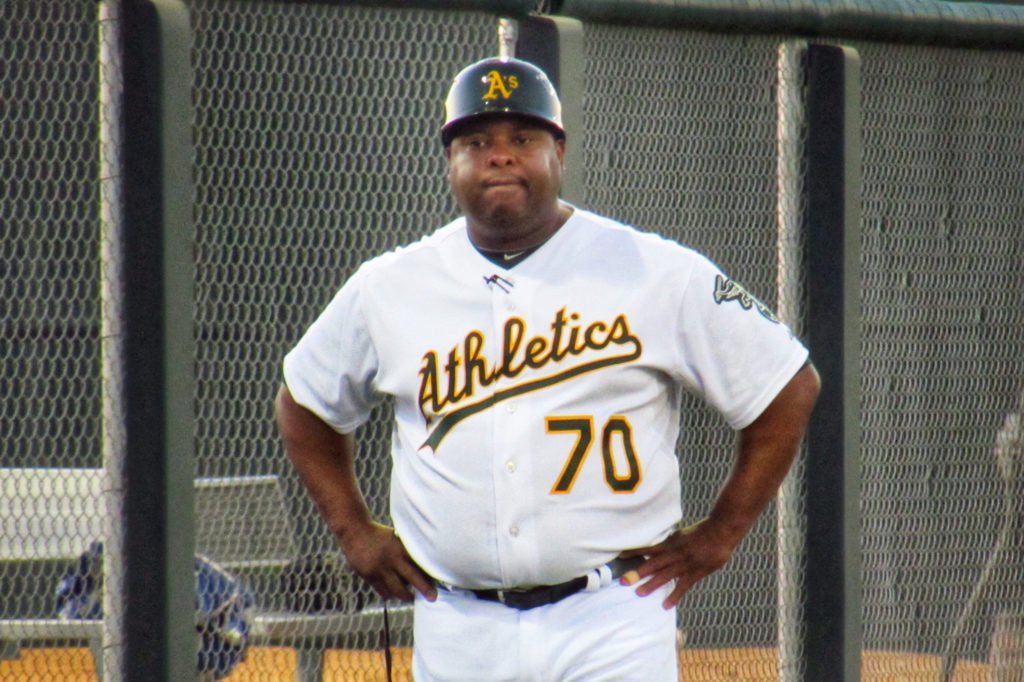
A’s minor-league manager Webster Garrison off ventilator in coronavirus fight — AP

A’s minor league manager off ventilator in coronavirus fight

A’s minor league manager off ventilator in coronavirus fight —
OAKLAND, Calif. (AP) — Oakland Athletics minor league manager Webster Garrison has resumed breathing completely on his own for the first time in more than three weeks and no longer requires a ventilator as he fights the coronavirus, his fiancee said Thursday.
Garrison, hospitalized in his home state of Louisiana, wasn’t yet speaking when Nikki Trudeaux posted her latest update Thursday.
“Webster Garrison is off the ventilator,” Trudeaux wrote, using a series of exclamation points. “He is still weak and can’t say words. He’s mumbling a little bit. That’s expected with that tube down his throat for that length of time and also being on all those sedatives so long. However, being on a ventilator for three weeks and one day, he is now breathing 100% on his own and his oxygen saturation level is at 100%.”

Trudeaux has been asking for nightly prayers and using the hash tag “WebbyStrong” as the 54-year-old former major leaguer fights COVID-19.
The A’s haven’t identified Garrison but released a a statement late last month that “a minor league staff member has tested positive for COVID-19 and is under hospital care.”
Garrison managed the Class A Stockton Ports last season, and he is scheduled to manage in the rookie level Arizona League this year. The ex-infielder played five games for the A’s in 1996, never getting a hit in 10 plate appearances while drawing one walk. He is from Marrero, Louisiana.
Trudeaux said she also tested positive for COVID-19 and described the emotional toll of not being able to be with Garrison during his illness. On Wednesday, she shared the encouraging developments such as that his eyes were open — and Trudeaux was hopeful he would be off the ventilator.
“He is smiling,” she posted. “He is wiggling his toes. He is just doing great!”
For most people, the new coronavirus causes mild or moderate symptoms, such as fever and cough that clear up in two to three weeks. Older adults and people with existing health problems can experience severe illness, including pneumonia and death.

Will Jalen Green’s NBA G League Deal Change College Basketball Forever? — NESN.com

A top college basketball recruit in the country has decided to skip the step all together, in a move that could potentially change a high schooler’s journey to the NBA forever. Jalen Green, the potential first-overall pick in the 2021 NBA draft, elected Thursday to sign with a brand-new G-League development program, according to ESPN’s…

Will Jalen Green’s NBA G League Deal Change College Basketball Forever? — NESN.com

Blue Jays staying fit and finding ways to keep feeling of momentum — Toronto Sun

Yes, Charlie Montoyo was impressed with the early work of pitcher Nate Pearson this spring and how could he not have been? Read More

Blue Jays staying fit and finding ways to keep feeling of momentum — Toronto Sun

es, Charlie Montoyo was impressed with the early work of pitcher Nate Pearson this spring and how could he not have been?

Ditto for the emerging play of Travis Shaw at first base, the revamped plate approach of Randal Grichuk and the renewal of potential from young stars Bo Bichette, Vlad Guerrero Jr. and Cavan Biggio.

But if there was one thing that stood out for the Blue Jays second-year manager in the abruptly ended Grapefruit League season was how the players were building as a team and thriving in a clubhouse with a notably different tenor than as recently as a year ago.

“We had great momentum going into season,” Montoyo said on Thursday during a conference call with Jays reporters. “The culture was great. The clubhouse was awesome and we don’t want to stop that.

“(There is) a lot of guys who want to lead. That’s great. The momentum that we had in spring training, how the team was talking to each other, it was pretty awesome. The personality was really starting to develop.”

From sport to sport, the benefits of such a culture can’t always be easily measured but if fostered from within a group with enough talent, can be a meaningful intangible.

To that end, even if the global COVID-19 pandemic has had other ideas, Montoyo said the Jays front office and coaching staff has been diligent about keeping that camaraderie alive and doing so by opening the lines of communication throughout the team.

Each coach on the big league staff has been designated responsibility for a group of players to touch base with regularly. Later this week, a Zoom conference has been arranged for the players to replace some of their usual hangout time from this part of the calendar through a virtual dugout.

“We’re staying in touch often,” Montoyo said. “Coaches, guys in the front office … our main goal is to make sure our players are safe and happy.

“Guys are talking to the players constantly. We’re doing the best that we can in this situation. We’re doing everything we can to make sure everyone is doing what it takes. Of course, no one knows how long this is going to last, so (preparations are) awkward.”

Like so many with the Jays, Montoyo is a baseball lifer who has lived the sport from his early days in Puerto Rico, to a long and colourful career coaching and managing in the minor leagues, to his big break with the Jays. So while family time at his home in Tuczon, Ariz., has no doubt been nice, not being around the sport has been a challenge.

Montoyo has heard the various proposals put forth for baseball’s return but didn’t want to venture into an opinion on them, even the one that suggested an entire season could be played further up his now home state in the Phoenix area.

“I love the fact that Major League Baseball and the union are coming up with ideas,” Montoyo said. “My focus is my work with the Blue Jays and making sure we are supporting our players. I don’t want to speculate on ideas because they are just ideas. It seems like there is a light at the end of the tunnel.”

Waiting for the all clear for a return is dodgy business, of course, and the Jays have been doing what they can to ensure players get whatever help is available. Montoyo said that strength coach Scott Weberg has been in touch with players to consult and develop fitness programs.

“The main thing is making sure they have places to work out depending on rules of whatever state they are in,” Montoyo said. “Everybody is doing what it takes. Some guys might have an indoor cage, a park next to the house … everybody is doing something to try to stay in shape for whenever that time comes.”

Pitchers have been adapting in a variety of ways, Montoyo said. Jordan Romano and Thomas Pannone are living together which affords them the opportunity to play catch, for example. Chase Anderson found a catcher who lives near him in his off-season home, for another. Hyun-Jin Ryu, Ryan Borucki and Pearson are among those who have made appearances at the team’s Dunedin base.

For now, all the work is of the maintenance variety and will remain that way until a path to the future is formalized. And through all that, Montoyo is remaining as patient as can be.

“I’m not only the manager of the Blue Jays, I’m also a fan of baseball,” Montoyo said. “I’m just hoping we can play baseball some time this year.

“It will be awesome for everybody. That would mean things are better. That would be great.”

Today in Baseball History: The Detroit Tigers become the “Tigers” — HardballTalk | NBC Sports

You will never guess, in 100 tries, what their name was before it was “Tigers.”

Today in Baseball History: The Detroit Tigers become the “Tigers” — HardballTalk | NBC Sports

For starters, let’s note that the franchise that would become the Tigers was not the first major league team in Detroit. That distinction belongs to the Detroit Wolverines, who were a new member of the National League in 1881. They lasted eight seasons — winning the National League pennant in 1887 — but folded during one of the NL’s early rounds of contraction after the following season. Mostly because the owner spent too much money buying up stars he couldn’t afford. It happens.

The Tigers, like a number of the teams which would become charter members of the American League, began as a minor league club in the upstart Western League. There had been earlier iterations of the Western League before that, but this one — formed by Ban Johnson and Charles Comiskey in the winter of 1893-94 — began play in 1894. In fact, the Tigers are the only original Johnson/Comiskey Western League team that still plays where they were founded that year.

The others:

  • Comiskey’s own Sioux City Cornhuskers, who would become the St. Paul Saints in 1895 and then move to Chicago and become the White Stockings — and later the White Sox — in 1900;
  • The Milwaukee Brewers, who would move to St. Louis to become the Browns in 1902 and, of course, would move to Baltimore to become the Orioles in 1954;
  • The Grand Rapids Rustlers, who wandered to St. Joesph, Missouri, then to Omaha Nebraska, and then to Columbus, Ohio to become the Senators, before they moved north to become the Cleveland Blues in 1900, after which they would switch to the Cleveland Broncos by around 1902, exist as the Cleveland Naps from 1903 through 1914 and then, finally, the Cleveland Indians in 1915. Wouldn’t be shocked if they change names again in my lifetime;
  • The Kansas City Blues, who would move to Washington to become the Senators franchise in 1901 and then move on to Minnesota to become the Twins in 1961;
  • The Toledo White Stockings, who also moved to Columbus, where they were the Buckeyes, and then were dropped entirely when the Buffalo Bisons were formed in 1899. Those same Buffalo Bisons lated only two years before they were dropped and were replaced by the Boston Americans who are today’s Boston Red Sox in 1901; and
  • The Minneapolis Millers and Indianapolis Indians who each just ceased to exist in 1901 in favor of a club in Baltimore, who would later become the Yankees, and a club in Philadelphia, which would then, as now, be known as the Athletics, even if they’ve moved cities a couple of times themselves.

Got that? If not, try to keep up. Thanks.

Anyway, the Detroit team was not the Tigers in 1894. They were sometimes called the Wolverines, as a throwback to the defunct NL team but they were more commonly known in their first season as . . . the Creams. Unlike a lot of early teams, however, this name was not a function of the colors they wore. Rather, they were called this because team owner George Vanderbeck boasted the team would be the “cream of the league.” In this I like to think of them as nominal cousins of the Brooklyn Superbas. And it makes me wonder if there were ever teams called the “Spiffys” or the “Swells.” If not, there probably should’ve been.

The Creams would really only last a season, however, because on this date in 1895, after their victory over a local semipro team known as the Athletics, Detroit Free Press editor Philip Reid wrote the headline “Strouthers’ Tigers showed up very nicely.” Strouthers, by the way, was the team’s manager, Cornelius “Con” Strouthers, who in 1905, as manager of the Augusta Tourists of the Sally League, would sign a young player by the name of Ty Cobb and subsequently sell his contract to the Detroit Tigers for $750. That happened the same month Cobb’s mother murdered his father (she was acquitted) but that’s a whole ‘nother story. Maybe we’ll cover it in August if we still don’t have any real baseball.

Anyway.

Where did Reid come up with the name “Tigers?” On one level it was probably just a nod to their ferocious play. “Go get ’em, Tiger,” and all of that. But there was a somewhat deeper connection at play here, as “Tigers” was also the nickname for the Detroit Light Guard, a unit of Michigan’s Army National Guard, which had fought in the Civil War and would soon fight in the Spanish-American War and which still exists today as the United States Army’s 1225th Corps Support Battalion. There would’ve been a lot of local pride surrounding that unit at the time, and most historians believe that Reid was invoking them in his usage. The team would formally ask the Light Guard for official permission to use “Tigers” around 1900, when the Western League changed its name to the American League, though they had been using it informally for five years by then.

Later in 1895 Vanderbeck decided to build the team their own park, called Bennett Park, at the corner of Michigan and Trumbull Avenues in downtown Detroit. The Tigers would play their first game there on April 28, 1896, defeating the Columbus Senators. Bennett Park was built on the cheap, with the smallest seating capacity in the Western League when it became the American League. It also was kind of dangerous, as they simply laid the dirt and sod over preexisting cobblestones, which would sometimes protrude out over the dirt. Talk about a hard slide. In 1911 the Tigers would make a move to get better digs when they purchased some land adjacent to Bennett Park, demolished the stands, turned the field 90 degrees and constructed Navin Field for the 1912 season.

Like the team, it too would change named, later becoming Briggs Stadium and then, finally, Tiger Stadium, which the baseball club formerly known as the Creams would play through the 1999 season. It was a pretty good place.

Also today in baseball history:

1929: Indians’ rookie center fielder Earl Averill homers off of Tigers pitcher Earl Whitehill, becoming the first American League player to hit a home run in his first major league at-bat;

1929: In that same game, the Indians become the first team to wear numbers on the back of their jerseys on a permanent basis. The Yankees would also adopt numbers permanently in 1929, but their April 16th game was rained out, so they wouldn’t take the field in them until the following day;

1935: Babe Ruth makes his National league debut, playing for the Boston Braves and hitting a homer and a single off Giants’ legend Carl Hubbell;

1940: Bob Feller tosses an Opening Day no-hitter, beating Chicago at Comiskey Park, 1-0;

1946: Harry Truman becomes the first President to throw the ceremonial first pitch left-handed;

1948: WGN-TV in Chicago televises a baseball game for the first time. It’s an exhibition game, with the White Sox beating the Cubs 4-1. Jack Brickhouse does the play-by-play;

1983: Padres first baseman Steve Garvey, playing against his old team, the Dodgers, for the first time, appears in his 1,118th straight game, breaking the National League record for consecutive games played, previously held by Billy Williams of the Cubs. Garvey’s consecutive game streak will end at 1,207 due to a dislocated thumb. On this same date, five years later, the Padres will retire Garvey’s number;

1988: The Braves establish a National League record for losses at the start of a season by losing their tenth consecutive game. With a 7-4 defeat to the Dodgers. This streak marks the beginning of my favorite season as a baseball fan.

Follow @craigcalcaterra

Joe Kelly Accidentally Shatters Window While Training In Backyard — NESN.com

Joe Kelly’s latest wild pitch is going to cost him. With the 2020 Major League Baseball season currently on pause, players across the league are forced to take matters into their own hands to keep their skills sharp. But if a video from Kelly’s at-home workout Wednesday is any indication, one of his pitches isn’t…

Joe Kelly Accidentally Shatters Window While Training In Backyard — NESN.com

Joe Kelly’s latest wild pitch is going to cost him. With the 2020 Major League Baseball season currently on pause, players across the league are forced to take matters into their own hands to keep their skills sharp. But if a video from Kelly’s at-home workout Wednesday is any indication, one of his pitches isn’t exactly operating at the highest level. Kelly’s wife, Ashley, shared clips of the Los Angeles Dodgers fireballer going through his throwing routine in their backyard. Not only did one pitch get away from Kelly, it sailed right through a window and resulted in quite the mess. You can check out the video here. On the bright side, replacing the broken window can make for a project to help kill time while quarantined.

Read more at: https://nesn.com/2020/04/joe-kelly-accidentally-shatters-window-while-training-in-backyard/

Ex-NBA Player Jason Collins Details Horrifying Experience With COVID-19 — NESN.com

Jason Collins was one of the first people to contract COVID-19 in the United States — and he caught a pretty bad case of the deadly virus. Luckily, the ex-NBA star, who played the 2012-13 season with the Boston Celtics, has recovered. But he said the two-and-a-half week period was “the sickest” he’s been in…

Ex-NBA Player Jason Collins Details Horrifying Experience With COVID-19 — NESN.com

Kendrick Perkins Says Rudy Gobert Is ‘Like A Savior’ After COVID-19 — NESN.com

Utah Jazz star Rudy Gobert’s positive test for COVID-19 was the first domino to fall, suspending the NBA season and inspiring every other league to do the same back on March 11. Since then, Gobert has donated money to outbreak relief causes and also apologized profusely. Especially since he did not take concerns seriously, to…

Kendrick Perkins Says Rudy Gobert Is ‘Like A Savior’ After COVID-19 — NESN.com

Dusty Baker frustrated by ‘dwindling’ number of black baseball players — HardballTalk | NBC Sports

On Jackie Robinson Day, Astros manager Dusty Baker said he is frustrated by the dwindling number of black players in Major League Baseball.

Dusty Baker frustrated by ‘dwindling’ number of black baseball players — HardballTalk | NBC Sports

Today is Jackie Robinson Day, commemorating the day in 1947 in which the former Dodgers second baseman broke baseball’s color barrier. His number, 42, has been retired throughout the league in 1997, though Yankees closer Mariano Rivera was allowed to continue wearing the number as he was grandfathered in. In the time since, players have begun all wearing the number 42 on Jackie Robinson Day.

Sadly, the percentage of black players in baseball has been on the decline. 7.7 percent of players on Opening Day rosters last year were black. According to SABR, black players haven’t been above 10 percent since 2004. They peaked at 18.7 percent in 1981.

Astros manager Dusty Baker is one of only two black managers in baseball along with the Dodgers’ Dave Roberts. Baker finds the lack of black players in the sport “frustrating,” Kristie Rieken of the Associated Press reports.

Baker said, “Hopefully in this decade and the next decade there will be more guys that get a chance. All they need is a chance. A lot of guys have been bypassed and overlooked.”

The issue is extremely complex and there are myriad factors for the lack of black players in baseball: political, social, and economic. Major League Baseball has, in recent years, made a concerted effort to reach out to a more diverse audience, but seeing that result in a player population change will likely take a while.